The main source of image formation is a gas discharge occurring close to the surface of the object under study. One can single out two main discharge types, related to formation of Kirlian images: an avalanche type, developing in a narrow clearance limited by a non-conductor, and the type sliding along the non-conductor surface.
The term “GDV-ography” was introduced for identification of a graghical registration method, and “GDV-grams (images)” – for the description of the image itself (by analogy with widely used terms encephalogram, cardiogram, etc.). The obtained data made it possible to formulate the definition of the method: Biological Emission and Optical Radiation, induced by electro-magnetic field, amplified by Gas Discharge with Visualisation due to computer data processing (BEO GDV).
As opposed to popular methods of medical visualisation, medical decision (diagnostic statement) in GDV-method is made not by means of anatomic structures study, but on the basis of conformal transformations and mathematical evaluation of multi-parameter images, whose parameters depend on psychophysiological state of the organism. At the same time basic physical processes tend to be the same both for biological (BO) and non-organic objects. Functional singularities of BO are manifested mainly in variability and dynamics of gas discharge images.
Gas discharge visualisation (GDV) principle can be presented as follows (see the drawing):
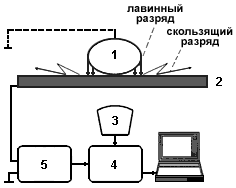 Voltage impulses from a magnetic field generator (5) are sent between the object under study (1) and dielecric plate (2), on which the object is placed. To ensure this a transparent conducting coating is applied on the back surface of the plate (2). With high field intensity in the gas medium of the space of contact between the object (1) and the plate (2) there develops an avalanche and / or sliding gas discharge (GD), whose parameters are determined by the object’s properties. With the help of optical system and camera (3) discharge glow is transformed into video-signals that are recorded as separate shots (GDV-grams) or AVI-files into memory block (4), connected to a computer processor. A computer processor is a specialised software complex that enables a researcher to calculate a number of parameters and to make certain diagnostic statements (medical decisions) on their basis.
The following institutions take part in GDV research:
In physics: IPMO (Institute of Precise Mechanics and Optics); Cybernatics Institute of the Russian Science Academy; Montreal University (Canada).
In medicine: St. Petersburg State Medical University named after academician Pavlov; Human Brain Institute of the Russian Science Academy (St. Petersburg); St.Petersburg Medical Military Academy; State Medical Academy of the city of Voronezh; Scientific Research Institute of Obstetrics and Pediatrics (the city of Rostov-na-Donu); Russian Academy of Ayurvedic Medicine; Institute of Orthodox Medicine; Space Medicine Academy; the University of the city of Kuopo (Finland), and Complementary Medicine Centers in 21 countries.
In psychophysiology and sports: the State Scientific Research Institute of Physical Culture and Sports; St. Petersburg Sports Academy; the International University, Stockholm; London City University.